
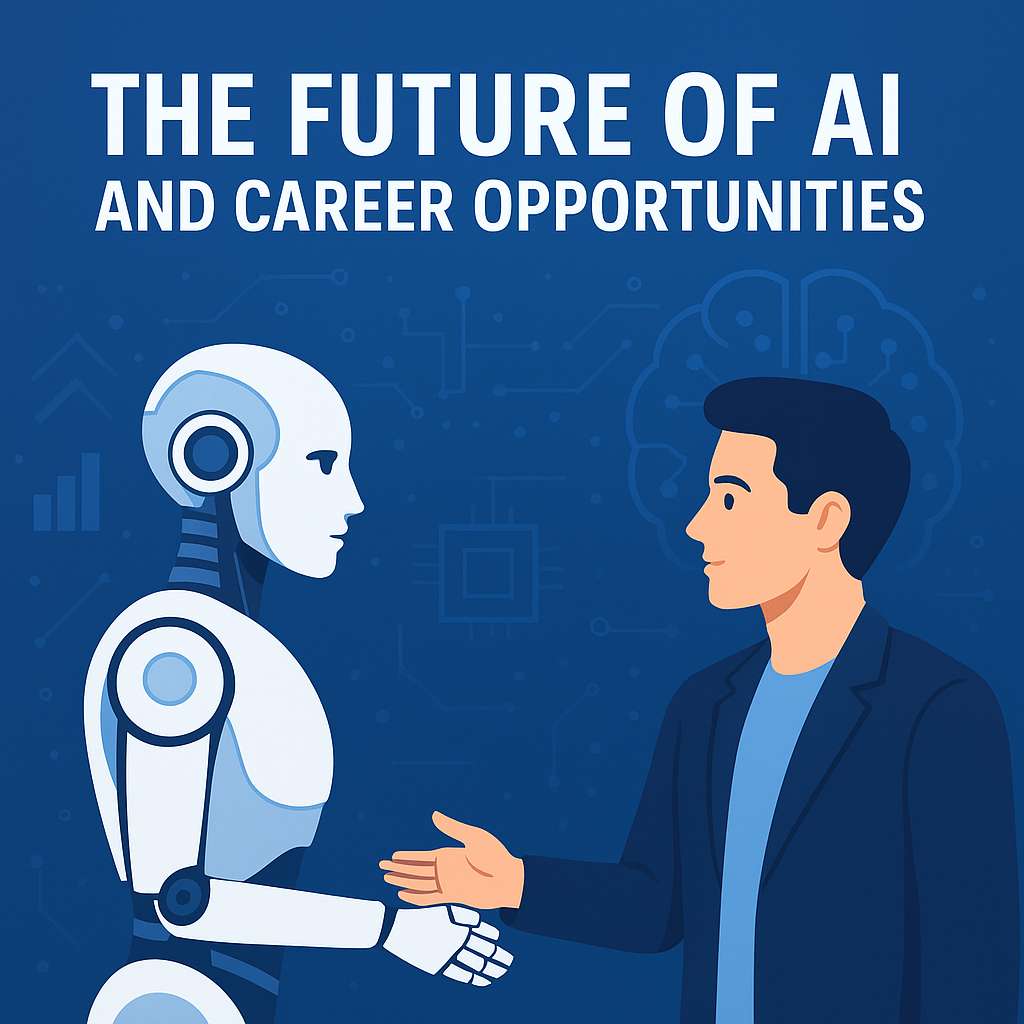
The Future of AI and Career Opportunities
Introduction
Artificial Intelligence (AI) is no longer a futuristic concept limited to research labs or science fiction movies. It has become a foundational technology that is transforming industries, redefining job roles, and creating entirely new career paths. From healthcare and finance to education, agriculture, and creative industries, AI systems now influence how decisions are made, how products are built, and how services are delivered. As automation and intelligent systems become more sophisticated, professionals across the globe are rethinking their career strategies to remain relevant in an AI-driven economy.
The future of AI is closely linked to the future of work. While some fear that AI will replace human jobs entirely, the reality is far more complex. AI is changing the nature of work rather than eliminating it. Many traditional roles are evolving, new hybrid professions are emerging, and demand for AI-related skills continues to rise. Understanding these shifts is essential for students, professionals, employers, and policymakers who want to prepare for the next decade.
This article explores the future of AI and the career opportunities it will create. It examines how AI is reshaping industries, which skills will be most valuable, what new job roles are emerging, and how individuals can prepare for long-term success in an AI-powered world.
AI as a Transformational Force in the Job Market
Artificial Intelligence acts as a general-purpose technology, similar to electricity or the internet. Its impact extends across nearly every sector of the economy. Organizations use AI to analyze massive datasets, automate repetitive tasks, enhance customer experiences, and optimize decision-making processes. As a result, productivity increases, costs decrease, and entirely new business models become possible.
However, this transformation also changes workforce requirements. Routine and repetitive tasks are increasingly automated, especially in areas such as data entry, basic customer support, and simple manufacturing operations. At the same time, jobs that require creativity, emotional intelligence, strategic thinking, and complex problem-solving are becoming more valuable. AI handles data-intensive tasks efficiently, but it still relies on humans to provide context, ethical judgment, and innovation.
Rather than replacing human workers, AI often augments them. For example, in healthcare, AI systems assist doctors by analyzing medical images or predicting disease risks, while physicians focus on diagnosis and patient care. In finance, AI models detect fraud and assess risk, while human experts interpret results and make final decisions. This collaboration between humans and intelligent machines defines the future of work.
Emerging AI-Driven Career Paths
As AI adoption accelerates, a wide range of new career opportunities continues to emerge. Some roles are highly technical, while others combine AI knowledge with domain expertise. One of the most in-demand roles is the AI Engineer, responsible for designing, building, and deploying AI systems. These professionals work with machine learning models, neural networks, and large datasets to create intelligent applications.
Another rapidly growing role is the Data Scientist, who analyzes structured and unstructured data to extract insights and train AI models. Data scientists require strong analytical skills, statistical knowledge, and programming expertise. Closely related is the role of Machine Learning Engineer, which focuses on optimizing algorithms and deploying models at scale.
Beyond technical roles, AI also creates opportunities in non-technical fields. AI Product Managers bridge the gap between business needs and technical teams, ensuring that AI solutions deliver real value. AI Ethics Specialists focus on responsible AI development, addressing issues such as bias, transparency, and data privacy. AI Trainers and Prompt Designers help refine AI outputs by guiding models with high-quality inputs and feedback.
Creative industries are also experiencing change. Designers, writers, and marketers increasingly use AI tools to enhance productivity and creativity. Professionals who understand how to collaborate with AI tools gain a competitive advantage, even if they do not build the technology themselves.
Skills Required for AI-Related Careers
Success in the future AI job market depends on a combination of technical, analytical, and soft skills. Technical skills remain critical for those directly working with AI systems. Programming languages such as Python, R, and JavaScript are widely used in AI development. Knowledge of machine learning frameworks, data structures, and cloud computing platforms is also highly valuable.
Equally important are data-related skills. Understanding how to collect, clean, analyze, and interpret data forms the foundation of AI-driven decision-making. Professionals who can translate raw data into actionable insights are in high demand across industries.
However, technical expertise alone is not enough. Soft skills play a crucial role in AI-driven careers. Critical thinking enables professionals to evaluate AI outputs and avoid blind reliance on algorithms. Communication skills help individuals explain complex AI concepts to non-technical stakeholders. Creativity and adaptability allow workers to innovate and respond to rapid technological changes.
Ethical awareness is another essential skill. As AI systems influence hiring, lending, healthcare, and law enforcement, professionals must understand the social implications of AI. The ability to design and use AI responsibly will define long-term career success.
Industry-Specific Opportunities Created by AI
AI-driven career opportunities vary significantly across industries. In healthcare, AI creates roles in medical data analysis, digital diagnostics, and personalized treatment planning. Professionals who combine medical knowledge with AI expertise are particularly valuable. In finance, AI supports algorithmic trading, risk management, and fraud detection, leading to demand for quantitative analysts and AI-savvy financial experts.
The education sector uses AI to personalize learning experiences and assess student performance. This creates opportunities for educational technologists and learning experience designers. In manufacturing, AI-powered automation increases efficiency and predictive maintenance, driving demand for robotics engineers and industrial data analysts.
The agriculture sector also benefits from AI through precision farming, crop monitoring, and yield prediction. Specialists who understand both agriculture and AI technologies can improve food security and sustainability. Even creative fields such as music, film, and content creation now require professionals who can integrate AI tools into their workflows.
Preparing for an AI-Driven Career Future
Preparing for the future of AI requires continuous learning and adaptability. Traditional education alone is no longer sufficient, as AI technologies evolve rapidly. Online courses, certifications, and hands-on projects play a critical role in skill development. Professionals should focus on building practical experience by working with real datasets and AI tools.
Networking also becomes increasingly important. Engaging with AI communities, attending conferences, and participating in open-source projects help individuals stay updated on industry trends. Employers value candidates who demonstrate curiosity, initiative, and a willingness to learn.
Career resilience depends on embracing lifelong learning. Instead of focusing on a single job title, professionals should develop transferable skills that remain valuable across roles and industries. Understanding how AI works, even at a conceptual level, benefits everyone, regardless of profession.
Ethical and Social Considerations in AI Careers
As AI becomes more powerful, ethical considerations grow in importance. Bias in AI algorithms can reinforce social inequalities if left unaddressed. Privacy concerns arise when large amounts of personal data are used to train models. These challenges create career opportunities for professionals who specialize in AI governance, policy, and ethics.
Organizations increasingly recognize the importance of responsible AI. Careers in AI ethics, compliance, and regulation will expand as governments and institutions introduce new frameworks. Professionals who understand both technology and ethics will play a key role in shaping the future of AI in society.
Conclusion
The future of AI presents both challenges and extraordinary opportunities. Rather than eliminating careers, AI reshapes them, creating demand for new skills, roles, and ways of working. Professionals who embrace AI as a tool for augmentation rather than competition will thrive in the evolving job market.
Career opportunities in AI extend far beyond programming and engineering. From healthcare and education to creative industries and public policy, AI influences nearly every field. By developing a combination of technical knowledge, soft skills, and ethical awareness, individuals can position themselves for long-term success.
Ultimately, the future of AI and career opportunities depends on how humans choose to design, deploy, and collaborate with intelligent systems. Those who invest in learning and adaptability today will shape the workforce of tomorrow.
Sources
- IBM – Artificial Intelligence Overview: https://www.ibm.com/topics/artificial-intelligence
- World Economic Forum – The Future of Jobs Report: https://www.weforum.org/reports/the-future-of-jobs-report
- McKinsey & Company – AI and the Future of Work: https://www.mckinsey.com/featured-insights/future-of-work
- Stanford AI Index Report: https://aiindex.stanford.edu/