
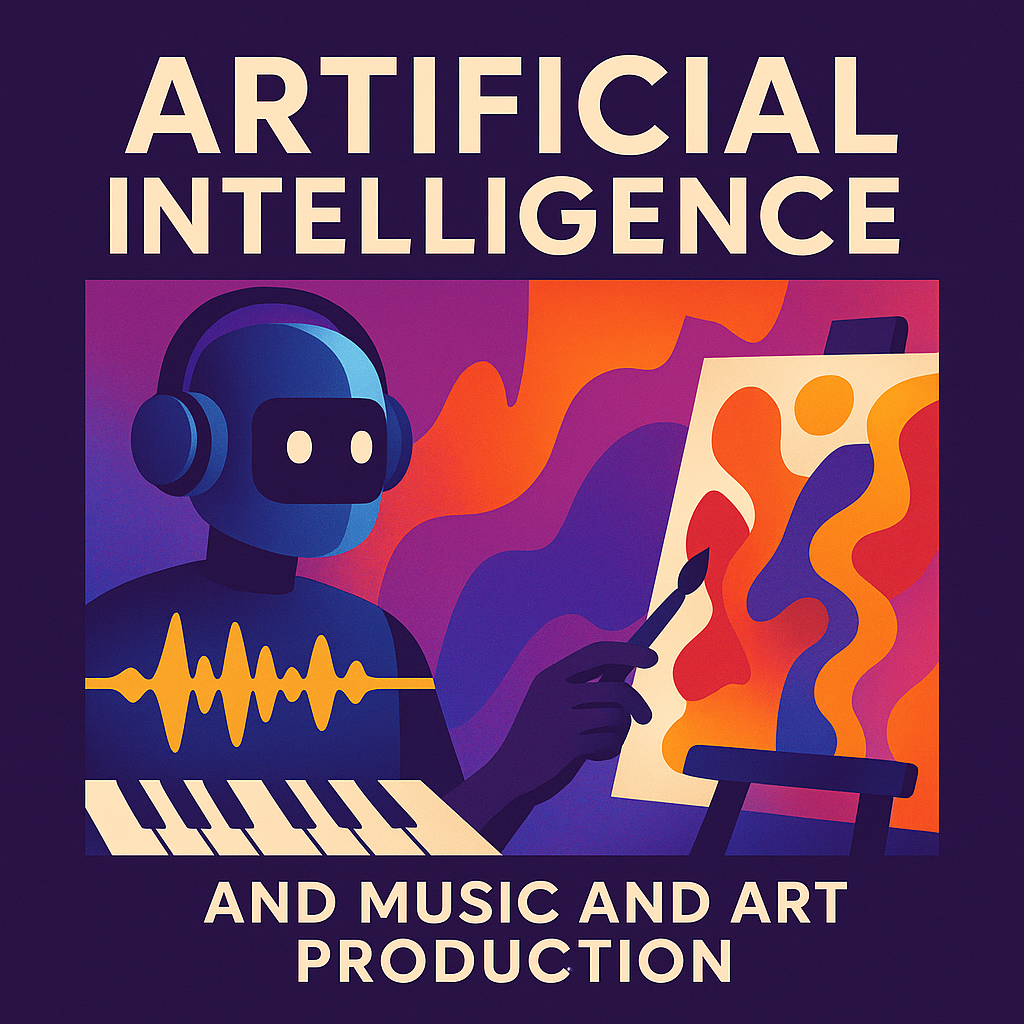
Artificial Intelligence and Music and Art Production
Introduction to Artificial Intelligence and Music and Art Production
The relationship between technology and creativity has always shaped artistic evolution. Today, Artificial Intelligence and Music and Art Production represent one of the most transformative intersections in modern culture. As machine learning, deep learning, and generative models continue to advance, AI becomes an active participant in creative workflows—composing melodies, generating artwork, enhancing audio, and even collaborating with human artists in real-time. What was once considered a purely human domain is now shared with intelligent systems capable of pattern recognition, style generation, emotional synthesis, and multimodal creativity.
AI-powered tools are reshaping traditional creative processes. Composers are using AI models to suggest harmonies, chord progressions, and orchestral arrangements. Visual artists employ generative models to produce illustrations, concept art, and dynamic visual effects. These systems are not replacing human creativity; rather, they are redefining the boundaries of what creativity can be. With tools like diffusion models, neural audio synthesizers, and large language–vision models, creators can experiment faster, explore more deeply, and access creative possibilities previously unimaginable.
The phrase Artificial Intelligence and Music and Art Production reflects a new era where machines act as partners in idea generation. AI understands musical styles, replicates artistic techniques, and explores creative variations across multiple mediums. These systems bring speed, infinite reproducibility, and novel aesthetic approaches—while humans provide emotion, context, and intentionality. This synergy marks the beginning of a hybrid creative future, challenging traditional definitions of authorship, originality, and craftsmanship.
As this field expands, creators must navigate ethical considerations, copyright implications, and cultural debates regarding authenticity. Nonetheless, AI’s role in artistic expression continues to grow, offering exciting potential for innovation, experimentation, and global creative collaboration.
AI in Music Production: Composition, Mixing, and Creative Collaboration
AI-driven tools are revolutionizing the music industry at every stage of production. In the context of Artificial Intelligence and Music and Art Production, music creation benefits from intelligent models that understand rhythm, pitch, harmonic structure, and genre-specific patterns. Composers now use AI assistants to generate melody lines, chord progressions, drum patterns, and even complete tracks. Platforms such as AIVA, Amper Music, and Google’s MusicLM demonstrate AI’s ability to compose music across classical, electronic, cinematic, and experimental styles.
AI also enhances sound engineering and mixing workflows. Intelligent mixing assistants analyze audio frequencies and automatically apply EQ, compression, and spatial adjustments. These systems are trained on the techniques of professional engineers, enabling newcomers and experts alike to produce balanced and polished mixes quickly. Mastering tools powered by deep learning can finalize tracks for streaming platforms within seconds, offering consistent loudness, clarity, and tonal quality.
Collaboration between humans and AI is becoming a new creative tradition. Musicians can improvise with AI-generated accompaniment, experiment with stylistic variations, or use AI tools to break through creative blocks. Some artists use AI as a “musical brainstorming partner,” generating dozens of sketches instantly. Others explore AI-driven sound design, using neural synthesis models that create entirely new timbres.
Despite the benefits, challenges remain. Ethical debates address whether AI-generated music should be copyrighted, whether datasets used to train models respect artists’ rights, and how AI may influence the identity of future musicians. Still, the synergy between human creativity and machine intelligence continues to push the boundaries of what is musically possible.
AI in Visual Art Production: Generative Models, Creativity, and New Aesthetics
In the broader field of Artificial Intelligence and Music and Art Production, visual art production has experienced some of the most dramatic advancements. Generative AI systems such as diffusion models and GANs empower artists to create stunning visuals—from abstract digital paintings to hyper-realistic illustrations. Tools like Midjourney, Stable Diffusion, and DALL·E enable creators to express complex visual ideas through simple text prompts, bridging imagination and execution.
AI brings new creative capabilities:
- It can learn from thousands of artistic styles and produce novel combinations.
- It can generate multiple variations in seconds, facilitating rapid prototyping.
- It enables collaborations where the artist guides the style, narrative, and mood, while AI handles execution.
This blend of human intention and machine capability leads to new aesthetics that did not previously exist. Concept artists, designers, filmmakers, and game developers now use AI to speed up visual ideation and world-building processes. AI-generated art is increasingly featured in exhibitions, advertisements, fashion campaigns, and music videos.
However, the rise of AI-generated art also raises questions of authenticity and authorship. If a model trained on millions of images produces a new artwork, who owns it? Should the artists whose works were used for training receive credit or compensation? These debates lie at the center of Artificial Intelligence and Music and Art Production, shaping the ethics and legal frameworks for future artistic practices.
Despite controversies, AI democratizes art creation. People with no traditional drawing skills can now produce visually compelling pieces. Professional artists can iterate faster and reach new creative depths. As AI tools evolve, the definition of art expands to include collaborative networks of humans and intelligent machines.
The Future of Artificial Intelligence and Music and Art Production: Ethics, Rights, and Creative Evolution
The future of Artificial Intelligence and Music and Art Production will be shaped by the balance between technological innovation and ethical responsibility. As AI becomes more integrated into creative industries, questions arise about authorship, originality, and the value of human creativity. The distinction between human-generated and AI-generated content will influence legal structures and cultural perceptions.
Copyright and intellectual property rights are among the most critical issues. Many argue that AI should be considered a tool rather than an author, attributing ownership to the human guiding the creative process. Others believe AI-generated works could exist in a separate legal category. Fair compensation for artists whose works are used to train AI models remains a central debate.
Culturally, AI challenges the romantic idea of the artist as a solitary genius. Instead, creativity becomes a shared process between humans and machines. For some, this expands artistic freedom; for others, it threatens traditional craftsmanship. Ultimately, Artificial Intelligence and Music and Art Production redefines creativity as a hybrid ecosystem where ideas flow between human vision and algorithmic exploration.
Looking forward, AI may create entirely new forms of art—interactive, adaptive, and personalized. Music that responds to listeners’ emotions, visual art that evolves with audience behavior, and immersive experiences powered by real-time generative systems are becoming possible. Multimodal AI models will unify sound, visuals, text, and interaction, enabling artists to create cross-disciplinary works effortlessly.
The future is not about AI replacing artists but amplifying them. By combining human intuition with machine intelligence, the creative world will expand beyond current limits. Ethical guidelines, transparent training data practices, and responsible governance will ensure that this new era of artistry benefits both creators and audiences.
References
- Google AI — Music and Creativity Research
https://ai.google - OpenAI — Generative Models for Art
https://openai.com - Adobe Firefly — Creative Generative Tools
https://www.adobe.com - MIT Media Lab — AI and Creative Expression
https://www.media.mit.edu - UNESCO — AI and Cultural Impact
https://www.unesco.org/en/artificial-intelligence